

Summary
Awards
Quick answer: An SBO licence is the IMDA licence you need to sell telecommunication services in Singapore over network capacity leased from a licensed operator. If you build or operate your own network to serve customers, you need an FBO licence instead. Some SBO services need only class registration.
You have a VoIP product, an IoT connectivity plan or a mobile brand ready for Singapore, and a carrier, investor or enterprise customer asks the same question: which IMDA licence do you hold? The answer usually turns on one point, whether you own the network or lease it, and it decides your fees, your timeline and what you must commit to once you launch.
This guide sets out how the Telecommunications Act 1999 and IMDA's published guidelines sort operators into facilities-based and services-based licences, what pushes a service into individual licensing, and where the Broadcasting Act 1994 comes in for streaming and media businesses.
When Does Singapore Law Require a Telecoms Licence?
If you operate or provide a telecommunication system or service to third parties in Singapore, you need a licence from the Info-communications Media Development Authority (IMDA). The Telecommunications Act 1999 gives IMDA the exclusive privilege over telecommunication systems and services, and running them without a licence infringes that privilege. Group-internal use is the main exception.
Section 3 of the Act vests the privilege in IMDA, and section 5 lets IMDA license others on conditions it sets, which can include interconnection and compliance with codes of practice.
Three points narrow the question. A company leasing capacity only to serve itself or its related corporations, as the Companies Act 1967 defines them, needs no SBO or FBO licence. The licensee must be a company incorporated, or a foreign company registered, under that Act, so an overseas provider usually needs a local entity or registered branch first; there is no foreign equity limit. And some services need separate approvals from other agencies.
IMDA spells it "licence"; overseas vendors often write "SBO license" or "FBO license". The instrument is the same.
SBO Licence vs FBO Licence: What Is the Difference?
The difference is ownership of the network. An FBO (Facilities-Based Operations) licence covers deploying or operating your own telecommunication network, systems or facilities to serve others. An SBO licence (Services-Based Operations) covers providing services over network elements leased from a licensed FBO, or reselling an FBO's services, to third parties.
FBO licence: you own or operate the infrastructure
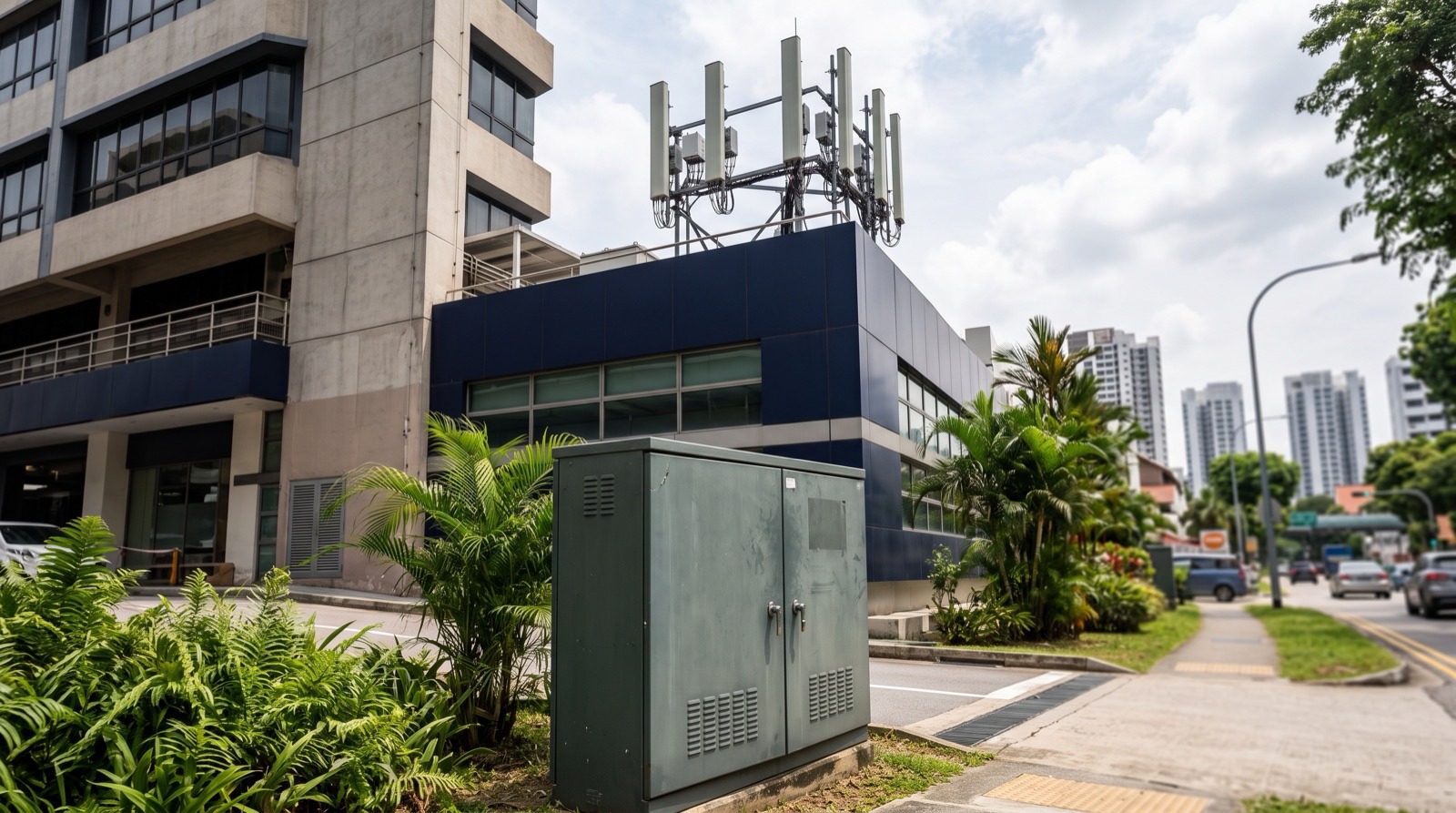
IMDA's FBO guidelines list the kinds of infrastructure that make an operator facilities-based: mobile base stations and switching centres, switches, optical fibre, ducts and manholes, submarine cable systems, and international cable and satellite gateways. Activating your own IRU (indefeasible right of use) capacity on a submarine cable, or lighting international dark fibre, to offer services in Singapore also requires an FBO licence.
The licensing framework is hierarchical. An FBO licensee may offer everything an SBO licensee can, but not the reverse, and IMDA intends each entity to hold a single licence. If you start as an SBO licensee and later build your own network, you apply for an FBO licence, which then replaces the SBO licence.
SBO licence: you run services on someone else's network
Most new entrants start here. You lease transmission capacity and switching from a licensed FBO and build your own service over it: a cloud calling product, managed connectivity for enterprise customers, an MVNO, or SIM-based connectivity for IoT devices. The SBO guidelines also catch an operator that deploys network only within its own property boundaries but serves third parties resident there, such as a building or campus operator.
SBO (Individual) or SBO (Class): Which One Applies?
It depends on the service. As a general rule, an operator that leases international transmission capacity to provide its services is individually licensed. Services such as MVNOs, IP telephony with local numbers, machine-to-machine connectivity and public internet access also sit in the individual category. A shorter list of lower-risk services needs only class registration.
What triggers individual licensing
IMDA's SBO guidelines list the services that require an SBO (Individual) licence. The ones founders most often meet are:
- International Simple Resale and other services built on leased international capacity, covering both voice and data traffic. Wholesale IP transit needs at least an SBO (Individual) licence even where the rest of your traffic only transits Singapore.
- IP telephony using E.164 telephone numbers assigned to customers in Singapore. IMDA's IP telephony guidelines require at least an SBO (Individual) licence, whether or not IMDA issued the numbers. SBO licensees are allocated numbers beginning with 3 only; numbers beginning with 6 are allocated to FBO licensees, though an SBO licensee can obtain level 6 service from an FBO commercially and must then meet extra conditions.
- Mobile virtual network operation, machine-to-machine services, virtual private network and managed data network services.
- Public internet access and internet exchange services.
- Prepaid services. A class licensee may not collect deposits or use prepaid cards to take payment, so a prepaid model needs individual licensing and paid-up capital of at least S$100,000 at the point of licensing.
What falls under the class licence
The SBO (Class) category covers call-back services, internet-based voice and data services, international calling cards, resale of public switched telecommunication services, store-and-forward and store-and-retrieve value-added network services, audiotex and public chain payphones. There is no individual assessment: you register through GoBusiness, and the gazetted terms in the Telecommunications (Class Licences) Regulations bind you from the start. Note the line between the two categories: internet-based calling is a class service, but once you assign Singapore E.164 numbers to customers, the IP telephony rules move you into individual licensing.
Whether calling or messaging inside a SaaS platform is a licensable telecommunication service at all depends on how it is built and sold. Settle that before launch, not when a customer's procurement team asks.
IMDA telecoms and media licences compared
What Does an SBO Licence Cost, and How Long Does It Take?
Per IMDA's published fees, an SBO (Individual) licence costs S$4,000 a year on the first S$50 million of annual gross turnover from licensable activities, and is valid for five years. Most SBO (Class) registrations cost S$200 once, and some carry no fee. An FBO licence starts at S$80,000 a year.

The detail, from IMDA's guidelines and SBO licence page:
- SBO (Individual): S$4,000 a year on the first S$50 million of annual gross turnover (AGTO), 0.5% of AGTO from S$50 million to S$100 million, and 0.8% above S$100 million. Valid for five years and renewable. IMDA awards a successful licence within 14 working days of a complete application, once its clarifications are done.
- SBO (Class): a one-time S$200 registration fee for services such as internet-based voice and data, call-back and calling cards; no fee for resale of public switched services, payphones, or store-and-retrieve services without leased circuits. No renewal is required.
- FBO: an annual fee of S$80,000 on the first S$50 million of AGTO, then 0.8% and 1% on higher bands, for a 15-year licence. There is no one-time fee, but you must lodge a performance bond, as an electronic banker's guarantee, of 5% of your total budgeted capital investment. IMDA generally decides within four weeks of a complete application.
The real time cost is preparation. SBO applications go through GoBusiness with an ACRA Bizfile report, service descriptions, network diagrams and a three-year capital expenditure projection. An FBO application needs five-year business, funding and rollout plans and three years of audited accounts, and binds you to what you commit. Both licensees file an audited AGTO statement within six months of each financial year end.
What Obligations Come With an IMDA Licence?
Licensing is the start, not the end. Every SBO and FBO licensee must comply with IMDA's Telecom and Media Competition Code 2022 and its licence conditions, keep IMDA informed of changes, and pay fees on audited turnover. Depending on the service, you may also carry quality of service, interconnection, numbering and accounting separation duties.
The obligations founders most often underestimate:
- Quality of service. IMDA grants an SBO (Individual) licence only if it is satisfied with your ability to deliver the service and your quality of service commitments. FBO licensees must meet IMDA's applicable QoS standards, and IP telephony on level 6 numbers must meet the standards for basic local call services, provide free access to 999, 995 and 993, and support number portability.
- Interconnection. FBO licensees must interconnect with other licensees; if negotiations with a dominant licensee fail within 90 days, either side may ask IMDA to resolve it.
- Change control. You need IMDA's prior approval before changing the scope of licensed services, and an SBO (Individual) licensee must notify changes to its particulars within five days.
- Accounting separation. SBO (Individual) and FBO licensees may be required to comply with IMDA's Accounting Separation Guidelines.
- Internet services. Public internet access and internet exchange providers must follow IMDA's IP "No Islanding" decision, and internet access providers must register with IMDA within 14 days of starting the service.
Much of this flows into your contracts: your capacity agreements with the FBO and your customer terms must match what the licence allows, which is where review of your technology and supply contracts earns its cost. Customer data you carry raises a separate set of duties under the PDPA, covered in our guide to PDPA obligations. Mapping the full set of regulatory duties before launch is part of our regulatory compliance advisory work for regulated businesses.
Do Streaming and Media Services Need a Licence Under the Broadcasting Act?
Often, yes, but under a different statute. The Broadcasting Act 1994, also administered by IMDA, governs television and online content services. A streaming or video-on-demand business serving Singapore typically needs a Niche Television Service Licence, which IMDA issues for five years with no licence fee, and must follow IMDA's content code.
IMDA's niche licence covers television services aimed at niche market segments and television services delivered over the internet, known as over-the-top (OTT) services. You apply through GoBusiness, and content must comply with the Content Code for Over-the-Top, Video-on-Demand and Niche Services. Nationwide free-to-air and subscription television services are separate licence categories for operators working at a larger scale.
Internet content and access providers are class-licensed automatically under the Broadcasting (Class Licence) Notification, so a telecoms operator offering internet access carries obligations under both Acts. Since 1 February 2023, the Broadcasting Act has also allowed IMDA to designate social media services with significant reach or impact in Singapore and require them to follow online safety codes. IMDA has designated only the largest platforms so far, so for most founders this is a point to watch rather than a launch requirement.
This article is general information on IMDA licensing, not legal advice on your situation.
Launching in Singapore With the Right Licence in Place
The licensing question rarely stops a launch outright; answering it late does. A customer's procurement review or an investor's due diligence asks for your IMDA licence, and you find your service needs individual licensing or a Singapore entity you have not set up. Settling the category early lets you plan the fee, timeline and commitments into your launch.
At Triangle Legal LLC, we advise founders and directors of technology and telecoms businesses on IMDA licensing as part of their wider regulatory and commercial position, with scope and fees agreed clearly at each stage. You can see who would handle your matter on our team page.
If you are weeks from launch and unsure whether your service needs an SBO (Individual) licence, class registration or something else, a wrong guess can cost you the launch date. In a complimentary 10-minute case assessment, we can identify which category your service is likely to fall in and what IMDA will expect to see.
SBO Licence and FBO Licence: Frequently Asked Questions
Q1: Do I need an SBO licence for a VoIP app?
If the app gives Singapore customers E.164 telephone numbers, IMDA's IP telephony guidelines require at least an SBO (Individual) licence, or an FBO licence if you run your own network. Internet-based voice and data services without local numbers fall in the SBO (Class) category. The answer turns on how the product is built and sold.
Q2: Can a foreign company hold an SBO licence in Singapore?
Yes, if it is a foreign company registered under the Companies Act 1967; a Singapore-incorporated subsidiary also qualifies. IMDA imposes no foreign equity limit on SBO licensees. Class licences may additionally be held by a limited liability partnership or limited partnership.
Q3: How long is an SBO licence valid?
An SBO (Individual) licence is valid for five years and is renewable every five years. SBO (Class) registrations do not need renewal. An FBO licence runs for 15 years.
Q4: Can I move from an SBO licence to an FBO licence later?
Yes. If an SBO licensee later deploys its own network, it applies for an FBO licence, and the FBO licence replaces the SBO licence. IMDA intends each operator to hold a single licence covering all its networks and services.
Q5: Do we need an IMDA licence if the service is only for our own group?
Generally not. A company that leases capacity from a licensed operator only to provide telecommunication services within itself or to its related corporations, as the Companies Act 1967 defines them, does not need an SBO or FBO licence. Once you serve outside customers, the licensing rules apply.
📧 contact@trianglelegal.com.sg
📞 +65 9247 3935
Author Bio: Nico Lee
Nico Lee is the Founder and Managing Director of Triangle Legal LLC, a partner-led Singapore law firm recognised in Asian Legal Business "Firms to Watch 2026". He advises SME founders, directors and creditors on disputes, debt recovery and corporate matters.


